
What Mercedes-Benz DYNAMIC SELECT Drive Modes Actually Do
- DYNAMIC SELECT adjusts throttle response, shift logic, steering feel, and suspension in one coordinated system.
- Eco, Comfort, Sport, Individual, and (on select SUVs) Off Road modes are tuned for efficiency, refinement, engagement, customization, and low-traction conditions.
- Switching modes helps match your Mercedes-Benz to Birmingham traffic, highway merges, wet-weather commutes, and backroad weekends.
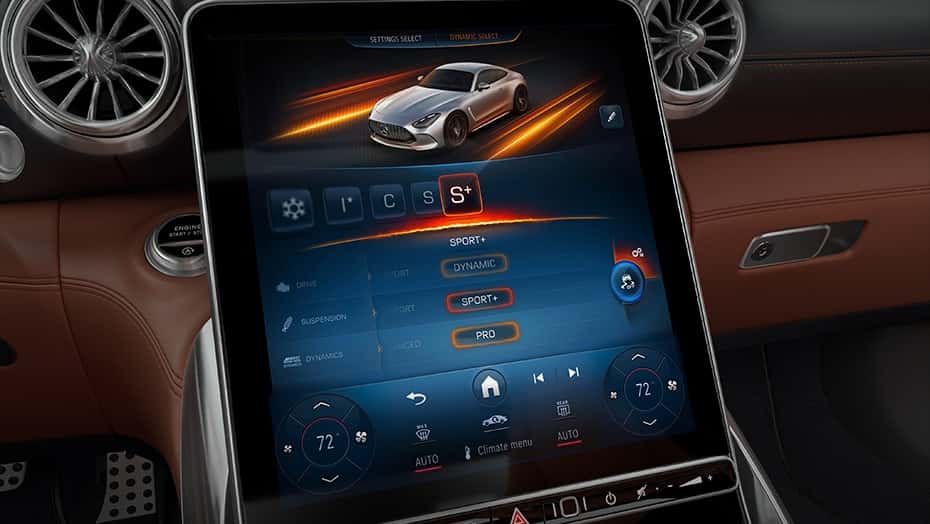
Your Mercedes-Benz responds differently when you press the accelerator in stop-and-go traffic versus when you’re merging onto the highway. That adaptability comes from DYNAMIC SELECT, a technology that transforms your vehicle’s character with a simple button press. Understanding how these drive modes work helps you get the most performance, comfort, or efficiency from your Mercedes-Benz, depending on what each moment demands.
What Is Mercedes-Benz DYNAMIC SELECT?
Mercedes-Benz DYNAMIC SELECT is a comprehensive vehicle control system that adjusts multiple performance parameters at once. When you select a different mode, the system modifies your engine’s throttle response, transmission shift points, steering weight, and suspension firmness in coordinated ways. These changes work together to create distinctly different driving experiences from the same vehicle.
The system lets you match your vehicle’s behavior to your immediate priorities. You might value fuel economy during your weekday commute, prefer a smooth ride for weekend trips with passengers, or want sharper responses when the road opens up. Dynamic select Mercedes technology makes these transitions seamless, giving you multiple vehicles in one.
Modern Mercedes-Benz models include DYNAMIC SELECT as standard equipment across most of their lineup. The system connects to your vehicle’s electronic control units, managing everything from air suspension height to how aggressive your automatic transmission behaves. This integration explains why switching modes creates such comprehensive changes in how your Mercedes responds.
How Drive Modes Change Your Vehicle’s Behavior
The transformation between Mercedes driving modes goes far beyond simple throttle mapping. When you change modes, your transmission adopts different shift logic, holding gears longer in Sport or upshifting earlier in Eco. Your steering system adds or reduces resistance, changing how much effort you need to turn the wheel and how directly the vehicle responds to inputs.
Suspension systems get new instructions based on your selected mode. Adaptive dampers firm up to reduce body roll during aggressive cornering or soften to absorb bumps more effectively. Even your climate control system adjusts, with Eco mode moderating fan speeds and temperature targets to reduce energy consumption.
Engine mapping changes significantly across dynamic modes. Sport mode increases throttle sensitivity, delivering more immediate power delivery from partial accelerator inputs. Eco mode does the opposite, requiring deeper pedal travel before requesting maximum power from the engine. These calibrations affect both how quickly your vehicle accelerates and how it feels throughout the power band.
The coordinated nature of these adjustments creates the distinctive character of each mode. You’re not just getting a faster throttle response in isolation. You’re experiencing firmer suspension that keeps the vehicle flatter through corners, quicker transmission shifts that maintain engine RPM in the power band, and heavier steering that provides more feedback. Everything works together to create a cohesive driving personality.
Understanding Each DYNAMIC SELECT Mode
Eco Mode: Maximizing Fuel Efficiency
Eco mode recalibrates your Mercedes-Benz to prioritize efficiency without completely sacrificing performance. The throttle response becomes more gradual, encouraging smooth acceleration patterns that consume less fuel. Your transmission shifts earlier, keeping engine speeds lower where fuel consumption stays minimal.
Climate control systems operate more conservatively in this Mercedes mode. The system may reduce maximum fan speed or allow slightly wider temperature variations before engaging the compressor. These small adjustments add up to measurable fuel savings over extended driving periods. The engine management system may also activate cylinder deactivation earlier on equipped models, running on fewer cylinders when full power isn’t needed.
This mode proves particularly valuable during extended highway cruising or congested urban driving where aggressive acceleration provides little benefit. You’ll notice the accelerator pedal feels less sensitive, requiring more travel to access full power. This characteristic encourages efficient driving habits while keeping adequate performance available when you need it.
Comfort Mode: Balanced Everyday Driving
Comfort mode represents the default setting on most Mercedes-Benz models, striking a careful balance between efficiency and performance. The suspension calibration softens to absorb road imperfections effectively, creating a smooth ride quality that reduces fatigue during longer journeys. Steering weight stays moderate, providing adequate feedback without requiring excessive effort during parking maneuvers.
Your transmission in Comfort mode shifts smoothly and relatively early, prioritizing refinement over sportiness. The system avoids holding gears unnecessarily while maintaining enough responsiveness for confident overtaking and merging. Throttle response sits in the middle ground, neither overly aggressive nor frustratingly dull.
This balanced approach makes Comfort mode ideal for daily driving situations where you want your Mercedes to feel luxurious without compromising practicality. The mode excels during commutes, errands, and highway cruising where extreme performance isn’t necessary. Passengers particularly appreciate Comfort mode’s focus on ride quality and smooth power delivery.
Sport Mode: Enhanced Throttle and Steering Response
Sport mode transforms your Mercedes-Benz into a more aggressive driving machine. Throttle response sharpens dramatically, with small accelerator movements producing immediate power delivery. The transmission holds gears longer, keeping engine speed elevated where maximum power and torque stay readily available. Downshifts happen more quickly when you lift off the throttle, using engine braking to scrub speed.
Suspension settings firm up considerably to reduce body roll during cornering. The vehicle feels more planted and composed through turns, with less vertical motion over bumpy surfaces. Steering weight increases, providing more resistance and feedback through the wheel. These changes create a more connected, engaging driving experience that rewards skilled inputs.
The exhaust system may also become more vocal in Sport mode on equipped models. Sound symposers or active exhaust valves open to deliver a more prominent engine note that reinforces the sporting character. This auditory feedback adds another dimension to the driving experience, making acceleration runs more engaging. Sport mode works best on winding roads, highway on-ramps, or any situation where you want to enjoy your Mercedes-Benz’s performance capabilities.
Individual Mode: Creating Your Custom Settings
Individual mode provides the ultimate flexibility within the mercedes dynamic select system. Rather than accepting the predetermined characteristics of other modes, you can mix and match settings to create your perfect combination. You might prefer Sport mode’s sharp throttle response combined with Comfort mode’s softer suspension, for example.
The customization menu typically allows independent adjustment of powertrain response, suspension stiffness, and steering weight. Some models extend these options to include transmission shift programs, exhaust sound, and stability control intervention thresholds. You can save these preferences so Individual mode recalls your exact specifications every time.
This customization capability proves valuable for drivers who find the preset modes don’t perfectly match their preferences. You might want quicker throttle response than Comfort provides without Sport mode’s firm suspension. Individual mode lets you create exactly that combination and hundreds of others. The system remembers your settings even after shutting down the vehicle, maintaining your personalized configuration.
Off Road Mode: Available on SUV and Crossover Models
Mercedes-Benz SUVs and crossovers equipped with 4MATIC® all-wheel drive often include Off Road mode as part of their driving mode select options. This setting optimizes traction and stability on loose or uneven surfaces where pavement driving modes would struggle. The system adjusts throttle response to prevent wheel spin, moderates braking intervention for controlled descents, and raises air suspension height on equipped models.
Off Road mode allows more wheelspin before traction control intervenes, helping you maintain momentum through sand, snow, or mud. The transmission favors lower gears to provide maximum torque at the wheels while avoiding abrupt shifts that could upset traction. Hill descent control may activate automatically, maintaining a steady crawl speed down steep grades without requiring constant brake application.
This mode transforms capable Mercedes-Benz SUVs into legitimate off-road vehicles. You gain confidence tackling unpaved roads, snowy parking lots, or muddy trails that would feel challenging in standard modes. The system’s calibration accounts for reduced traction and rough surfaces, making the vehicle more predictable and controllable in adverse conditions.
Matching Mercedes Drive Modes to Birmingham Conditions
Birmingham’s diverse driving environment presents distinct opportunities to use different benz driving modes effectively. Morning commutes along I-20 and I-459 often involve dense traffic where Eco mode’s fuel-saving characteristics make practical sense. The moderate throttle response and early upshifts suit the stop-and-go patterns while reducing fuel consumption during extended idling periods.
Weekend drives through the surrounding Alabama countryside reward switching to Sport mode. The winding roads through areas like Oak Mountain State Park showcase what your Mercedes can do with sharper responses and firmer suspension settings. The enhanced steering feedback helps you place the vehicle precisely through corner sequences while the aggressive transmission programming keeps power readily available.
Summer thunderstorms that sweep through the Birmingham area create temporarily slick conditions where Comfort mode’s balanced approach provides confidence. The softer suspension maintains better tire contact over wet pavement while moderate throttle response reduces the chance of unwanted wheelspin. SUV owners tackling wet grass at outdoor events can switch to Off Road mode for additional traction management.
Individual mode proves particularly useful for Birmingham drivers who frequently transition between downtown parking garages and highway driving. You might configure lighter steering for maneuvering tight spaces while maintaining Sport mode’s responsive powertrain for confident highway merging. This mixed approach adapts to the varied demands of metropolitan driving without constant mode switching.
How to Switch Between DYNAMIC SELECT Modes
Most Mercedes-Benz models position the DYNAMIC SELECT controller on the center console, typically near the transmission selector or as part of a rotary dial system. The interface provides intuitive access to all available drive modes through simple rotation or button presses. A display screen confirms your selection and may show which specific vehicle systems are changing configuration.
The transition between mercedes selection modes happens nearly instantaneously. You’ll feel throttle response change within the first accelerator input after switching. Suspension adjustments on adaptive damping systems take effect within milliseconds, though you’ll notice the difference most clearly over bumps or during cornering. Transmission programming updates immediately, affecting the next shift event.
Some Mercedes-Benz models integrate mode selection into the steering wheel controls or touchscreen interface. These alternative access points provide convenience without requiring you to reach for the center console. The digital instrument cluster displays your current mode prominently, ensuring you always know which configuration is active. You can switch modes at any speed and during any driving condition without risk to vehicle systems.
Newer Mercedes-Benz models may include automatic mode switching based on driving style recognition. The system monitors your accelerator and brake inputs, along with cornering forces, to detect when you’re driving aggressively. It can automatically engage Sport mode characteristics without requiring manual selection, then return to your chosen default mode during relaxed driving. This intelligent adaptation ensures optimal vehicle response matches your intentions.
Experience DYNAMIC SELECT at Mercedes-Benz of Birmingham
Testing drive mode select capabilities yourself shows how dramatically these systems transform vehicle character. Visit us at the Hoover campus at 1800 Montgomery Hwy S or the Irondale campus at 750 Mercedes Way to explore our full inventory of models equipped with DYNAMIC SELECT. Feeling the contrast between modes in person provides clarity that descriptions alone cannot match. Our factory-trained product specialists can demonstrate how to access and configure each mode while explaining the specific systems affected in your model of interest.
Contact us to schedule a test drive and discuss which models and configurations best match your driving priorities. Whether you value efficiency, performance, versatility, or customization, specific Mercedes-Benz models emphasize different aspects of the DYNAMIC SELECT system. Personal consultation helps identify vehicles that align with how you actually drive rather than generic recommendations.
The DYNAMIC SELECT system represents Mercedes-Benz’s commitment to driver-focused technology that enhances every journey. By understanding how each mode modifies vehicle behavior and learning when to use them, you transform your Mercedes from a single-purpose machine into an adaptable platform. That versatility ensures your vehicle stays engaging and appropriate regardless of changing conditions, priorities, or moods behind the wheel.
Frequently Asked Questions
What does Mercedes-Benz DYNAMIC SELECT change?
DYNAMIC SELECT coordinates multiple systems at once, including throttle response, transmission shift points, steering weight, suspension firmness (when equipped), and certain comfort/efficiency behaviors like climate control strategies.
Which DYNAMIC SELECT mode is best for everyday driving?
Comfort mode is typically the best everyday choice because it balances smooth ride quality, refinement, and responsiveness for commutes, errands, and highway cruising.
Can you switch DYNAMIC SELECT modes while driving?
Yes. Mode changes take effect quickly, and you can switch at any speed; you’ll typically feel changes in throttle response and transmission behavior immediately after selecting a new mode.
How does Individual mode work?
Individual mode lets you mix and match settings—such as powertrain response, suspension calibration, and steering feel—so the vehicle behaves exactly how you prefer instead of using a preset mode.