
Mercedes-Benz Off-Road Cockpit Explained for GLE and G-Class Drivers
Few luxury SUVs let a driver see the terrain beneath their front bumper before a wheel ever touches it. Mercedes-Benz built exactly that capability into the G-Class, and it’s one of the clearest examples of how far Mercedes-Benz Off-Road Cockpit engineering has come. If you’re weighing a G-Class or a GLE for weekend trips off the pavement, we can walk you through both systems in person. Browse our new GLE and G-Class models or contact our team to schedule a test drive if you’d rather see this technology firsthand.
This article breaks down what the Off-Road Cockpit actually displays, how it differs from the GLE’s Off-Road Mode, and why either system matters for drivers dealing with Alabama’s mix of pavement, gravel, and rural terrain.
What Is the Mercedes-Benz Off-Road Cockpit?
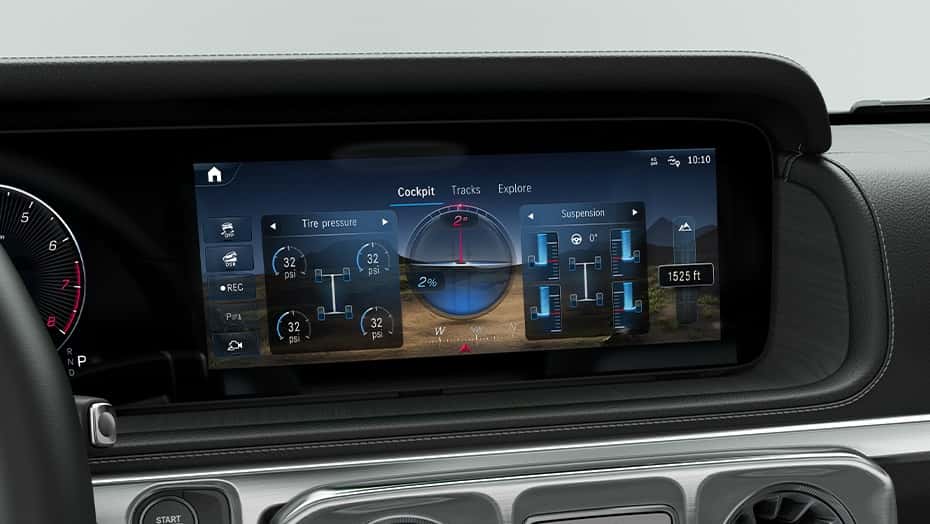
The OFFROAD COCKPIT is a dedicated function built into MBUX, the G-Class’s onboard operating system. It pulls real-time terrain and vehicle data onto both the driver’s digital cluster and the central touchscreen, giving the driver a full picture of what the vehicle is doing beneath and around it. Drivers can customize which data tiles appear, cycling through them with directional arrows or a simple swipe across the 12.3-inch touchscreen.
This isn’t a generic trip computer repurposed for trails. It’s built specifically for low-speed, technical driving, where a driver needs to know the vehicle’s exact orientation before committing to a line over rocks or through a rut.
Key Data the Display Shows: Angle, Incline, Suspension, and Cameras
The Off-Road Cockpit displays vehicle positioning, altitude and elevation, steering angle, torque output, a compass heading, ambient temperature, and individual tire pressure readings. All of it appears on the 12.3-inch touchscreen and mirrors onto the digital instrument cluster, so the driver never has to glance away from the road for long.
The system also taps into the 360-degree camera for a feature called Transparent Hood, which projects a virtual view of the ground beneath the front of the vehicle. That view reveals obstacles and ruts that would otherwise be hidden by the hood itself, helping the driver place each wheel with precision. Transparent Hood only activates in specific drive modes and below certain speeds, since it’s designed for deliberate, technical maneuvering rather than highway use.
New drivers sometimes lean on the camera view alone, without cross-checking the steering angle and torque readouts. Another mistake is committing to a wheel path before confirming the vehicle’s lateral tilt on the display. Off-road driving should only be attempted by drivers with the appropriate skill and experience, and every owner should review the Operator’s Manual before heading onto technical terrain.
G-Class: The Off-Road Cockpit’s Home Turf
The Off-Road Cockpit exists because the G-Class was built to use it, starting with the frame itself. Standard equipment includes body-on-frame ladder construction, three mechanical differential locks, LOW RANGE gear reduction, a solid rear axle, and independent front suspension. That’s a hardware list you won’t find on most luxury SUVs, and it’s the reason G-Class off-road capability sits in a different category entirely.
The numbers back it up. The G-Class offers 9.5 inches of ground clearance between the axles, a maximum fording depth of 27.6 inches, and stability on lateral slopes up to 35 degrees. Its approach angle measures 30.6 degrees and its departure angle 29.9 degrees. On suitable surfaces, it can climb grades up to 100 percent. Few production vehicles wearing a luxury badge can match that spec sheet.
How G-Class Drivers Use the Cockpit on Rugged Terrain
Picture a steep, rutted incline on a private trail. As the G-Class approaches, the Off-Road Cockpit’s incline readout climbs steadily, the compass confirms heading, and the Transparent Hood view shows a hidden rock ledge just past the crest. The driver eases off the throttle, lets G-Mode manage damping and steering response, and picks a line that avoids the ledge entirely, guided by the display rather than guesswork.
G-Mode engages automatically whenever a differential lock or LOW RANGE is activated, adjusting damping, steering feel, and accelerator response for the terrain at hand. Drivers select from DYNAMIC SELECT modes, ECO, Comfort, and Sport for on-road driving, plus Trail, Rock, and Sand for off-road work. Sand mode prioritizes grip and steerability on loose surfaces, Trail handles soft or slippery ground, and Rock is built for steep terrain with severe axle articulation. Electric G-Class models use ELECTRIC DYNAMIC SELECT with Comfort, Sport, Trail, and Rock. Drivers can also choose between three display styles, Classic, Sporty, and Progressive, to suit their preference for how the data is presented.
GLE and the Off-Road Mode with Transparent Hood Display
The GLE takes a different approach. Rather than a standalone branded system, it offers Off-Road Mode as one of four MBUX display modes, alongside Navigation, Assistance, and Service. Off-Road Mode converts gradient, roll angle, compass heading, and steering angle into a clear visual layout on the display, giving GLE drivers meaningful terrain feedback without the dedicated hardware of a G-Class.
The GLE also gets Transparent Hood when equipped with the Surround View system and its 360-degree camera, showing a virtual view under the front of the vehicle including the front wheels and their steering position. That lets a driver spot a rut or rock before it becomes a problem.
For drivers who want more, the available Off-Road Engineering Package on the GLE 580 4MATIC® adds an underride guard for underbody protection, a dedicated OFFROAD drive mode, and, in combination with AIRMATIC® air suspension, 1.2 inches of additional ground clearance. GLE drivers can also select from three display styles, Classic, Sporty, and Discreet, alongside four display modes: Navigation, Assistance, Service, and Off-Road.
How the GLE’s Current Tech Compares to the Off-Road Cockpit
The GLE’s Off-Road Mode is genuinely useful, but it’s a different system from the G-Class’s OFFROAD COCKPIT, and we want to be upfront about that. The GLE displays similar categories of terrain data, gradient, roll, steering angle, but it does so as one mode within MBUX rather than as a purpose-built off-road interface with the depth of tile customization the G-Class offers.
In practical terms, this reflects what each vehicle is built to do. Mercedes-Benz says it designed the current package around the reality that most GLE drivers travel on paved roads or in easy to moderately difficult off-road terrain, and the GLE handles gravel, light trails, and rough driveways accordingly, especially with the Off-Road Engineering Package on board.
The G-Class is a dedicated 4×4 platform, built around three mechanical differential locks and LOW RANGE gear reduction, for serious technical terrain. Mercedes-Benz has confirmed its MB.OS platform is coming to future models, and a more dedicated cockpit-style display could follow in a later GLE generation, though nothing is confirmed for the GLE today.
The table below summarizes how the two models differ where it matters most for off-road use.
Why This Technology Matters for Alabama Drivers
Alabama’s terrain isn’t the Rockies, but it’s far from uniformly paved. Drivers around Birmingham, Hoover, and Irondale regularly deal with gravel roads and red-clay driveways that turn soft and rutted after rain. That’s exactly the environment where Off-Road Mode and the Off-Road Cockpit earn their keep.
Unpaved Roads, Lake Access, and Rural Properties
Rural properties throughout Alabama often sit at the end of long gravel or dirt drives, and lake access roads can turn to mud fast during wet seasons. In these conditions, Off-Road Mode allows more wheelspin before traction control intervenes and favors lower gears for added torque, which helps maintain momentum on loose or slick ground. Hill descent control can also activate automatically, holding a steady crawl speed down steep grades without the driver riding the brakes.
Steep Driveways and Weekend Adventure Routes
Steep, uneven driveways are common in the hills around Birmingham, and a GLE with the Off-Road Engineering Package handles that added clearance with ease. For drivers chasing rougher weekend routes, whether that’s a gravel fire road or a technical trail, the G-Class’s locking differentials and LOW RANGE give a meaningful edge that a standard SUV simply can’t match.
Choosing the Right Model for Your Off-Road Needs
If your off-pavement driving is mostly gravel roads, lake access, and the occasional rough driveway, a GLE with the Off-Road Engineering Package likely covers everything you need while still delivering everyday luxury and comfort. If you’re regularly tackling technical trails, steep rocky terrain, or serious mud and sand, the G-Class and its dedicated Off-Road Cockpit are built specifically for that kind of demand.
Either way, we’d encourage you to think honestly about how often you’ll actually use these systems. Our sales team can walk through your typical routes and terrain to help match you with the right model, whether that’s a new vehicle, one of our certified pre-owned vehicles, or an option from our pre-owned inventory.
Ask Mercedes-Benz of Birmingham About Off-Road-Ready Models
Reading a spec sheet only gets you so far. Sitting in a GLE or G-Class and cycling through the display modes yourself makes the difference between the systems immediately clear.
Questions Worth Asking Our Team
Our factory-trained technicians and experienced sales team can walk you through exactly how the Off-Road Cockpit and Off-Road Mode function. Worth asking: which trims include the Off-Road Engineering Package, how the G-Class’s mechanical differentials compare to the GLE’s air suspension options, and which display style best fits how you plan to use the vehicle.
Visit Us in Hoover or Irondale
Visit us at either our Hoover or Irondale campus, both convenient stops for Birmingham-area drivers, or contact our team to schedule a test drive and see these systems in action for yourself.